




Reviews
De Stentor, Jeroen Pol, September 09, 2024
Wet eyes during the final applause: former employees see their Zwitsal factory come back to life.
The togetherness, the family feeling of that time, came back to many former employees. Some got wet eyes and wiped away a tear. A number of things were very recognizable, especially in the details. The quick walk with which the canteen was sought after the sound of a buzzer. The activities of the employee association. Or those times when a fake mouse was brought along to scare the ladies in the packing department.
With limited resources, [they] have created recognizable sets. The packing tables. The office upstairs. The pipes for the extraction. And there are top actors on stage. Done really well.

De Theaterkrant, Iris Spanbroek, September 08, 2024
It is a story that reflects the real concerns and problems of the Zwitsal family business and at the same time is fictional enough that many companies or organizations can be recognized in it. In everything, from the many yellow bottles to the local players, the affection and enthusiasm for this production can be felt.
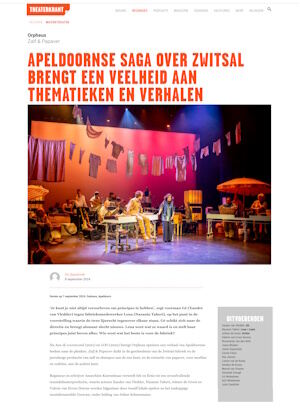
Prepublicity
Orpheus Magazine, Sandra van Maanen, July 07, 2024
Salve & Poppy is a story with a direct link to Apeldoorn and its inhabitants. Zwitsal has meant a lot to people here. We also opt for collaboration between professional actors and people from Apeldoorn. In this way, the city and its inhabitants are given a stage. This piece goes a step further than two previous productions because it is about factory work, the family-like feeling that prevailed here. It is therefore also about the concerns of employees, about confrontations when takeovers or mergers threatened and about things that would change that would cause the family to fall apart. Many people will recognize all the uncertainties that this creates.
The title tells it all: Zwitsal produced something else besides soap and ointment. Medicines including narcotics such as morphine and codeine. The raw material for all these substances is poppy. If you take too much of it, it becomes addictive and you end up in a trance, in a dream world if you like. This fact makes my imagination run wild. What was it like to secretly participate in this? What did employees dream about during their work in the chemical department, preparing yet another box of opiates? What did they know about growing poppies, about life in the Middle East? Did they ever think about the people there, colleagues at a distance who were involved in the cultivation? And did they realize that they remained poor while big money was being made here? Salve & Poppy is the story of two completely different worlds that had more in common than we thought. In fact, nothing has changed, it is still exactly the same now. Poppy is and remains an ingredient to dream away with.
The story is also about being checked every day to prevent you from taking anything. We spoke with [employees] about the pressure that this caused, but also about the tension they felt because everything had to be cheaper and more efficient. The chance of being taken over grew. As did the fear that everything would change, which would mean the end of the family feeling. With all those truths my mind got into the act.
Salve & Poppy is musical theatre, a theatrical fairy tale in the atmosphere of 1001 nights. You get the chance to dream away for a while, just like the employees of the factory did at the time. It is a kind of parable, a story that makes you look at your own life with a bit of distance. And maybe the story itself learns you a lesson, We have lost that ability a bit in the West, which I think is a shame.

Omroep Gelderland, Marjolein Deurloo, September 10, 2024
It was a women’s team, separated from the men who worked in the back of the factory. There, behind closed doors, opium was processed. Joyce and her colleagues had no idea. “We saw the men walking around, but nothing else.”
If this story is not told, it will disappear. Although it is very important,” says Koerselman. “The Zwitsal factory was the heart of working Apeldoorn, something to be proud of. Also the history with the poppy.
Painkillers such as morphine and codeine were made from poppies. According to Koerselman, Cor Jansen, the founder of Zwitsal, made a lot of money with it: “I think he was good at marketing. He undoubtedly realized that baby shampoo was better marketed than morphine and codeine, which were his biggest earners. Zwitsal was more of a side issue.”
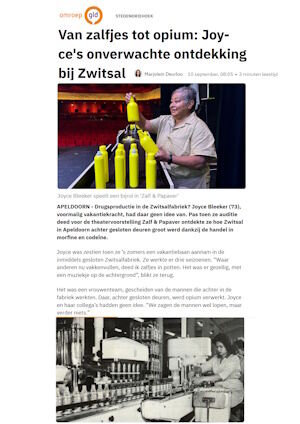
Stentor, Johannes Rutgers, Augustus 10, 2024
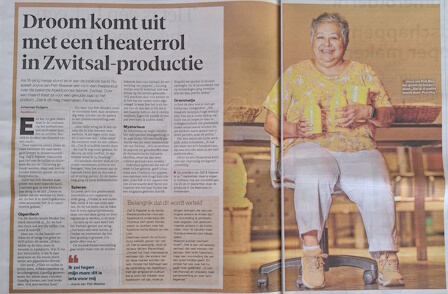
AD, Chantal Zwaag, June 20, 2024
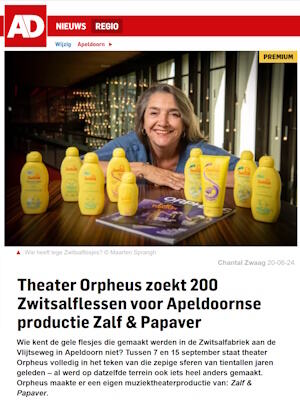
AD, Johannes Rutgers, November 12, 2023
Theater Orpheus, December 12, 2023