






Reviews
De Volkskrant, Maartje Stokkers, September 28, 2025
The September Me Festival has a wonderful premiere with the opera about the life of Charlotte Salomon!
A clever move by librettist and director Annechien Koerselman is the setting of a family constellation.
And that last part is what gives the performance its air. The musicians all navigate the narrow space between laughter and tears with virtuosity.
Charlotte Salomon – Life? or Theatre? is highly recommended.

Nederlands Dagblad, Margaretha Coornstra, October 03, 2025
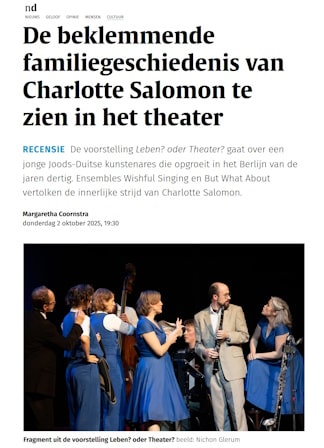
Yet, in "Life or Theatre?" the focus isn't on Nazism, though accordionist and singer Wilco Oomkes delivers a viciously menacing performance of "The War." Charlotte's troubled family history, or rather, her struggle with it, takes center stage.
Her family history is reconstructed through a family constellation. A wonderful discovery, which also provides insight for the public.
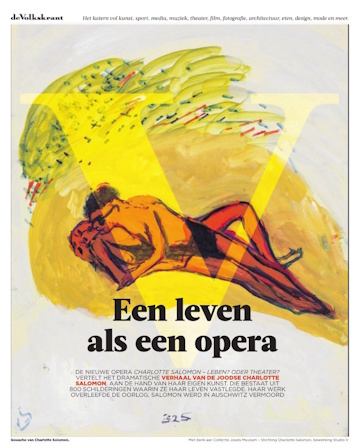
A fascinating backdrop is formed by the passing gouaches of Charlotte Salomon, which consistently illustrate the events on stage via the projection screen.
Surprisingly, the role of Charlotte is played by four singers from Wishful Singing. Moreover, her characters sometimes split into four: a soprano and alto duo for the insecure 22-year-old Charlotte, and a similar duo for the more mature 25-year-old Charlotte, who encourages her younger alter ego.
[Annechien Koerselman] Her choice of a German libretto wasn't just for the local flavor. "German just sings a little better."
The performers are also demanded quite a bit of motor skills. Imagine bowing the double bass while simultaneously singing and acting. Or two people taking a synchronized run-up and then jumping onto a chair with their arms outstretched.
Despite the heavy subject matter—suicide—the creators have managed to keep this Singespiel lighthearted. This is partly thanks to the historical Charlotte Salomon, who didn't shy away from self-irony and gallows humor in her posthumous writings.
The result is a balanced, meticulously crafted whole. Timing, facial expressions, diction, controlled volume changes: everything falls into place.
Operamagazine, Franz Straatman, October 03, 2025
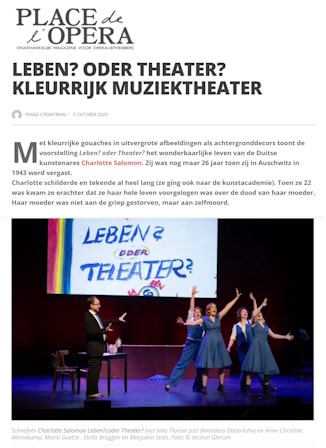
The musicians played, sang, and acted out the male characters. They did so with convincing dedication, with Wilco Oomkes portraying the terrifying figure of "War" with loud Nazi screams. He represents the dark side of Germany from 1933 onward, while Charlotte yearns for freedom.
Baritone Florian Just plays a key role. His character, Amadeus Daberlohn, is based on Charlotte's friend Alfred Wolfsohn. His character has been given more weight in the libretto, acting as a mental coach for the searching Charlotte.
Thanks to the wonderful vocal and acting skills of the Wishful Singing group, this production about the life and work of Charlotte Salomon is highly recommended. Moreover, the audience gets a wonderful overview of the artist's colorful fantasies.
Basia Con Fuoco, Neil van der Linden, October 18, 2025
Half diary, half opera, Leben? oder Theater?: Ein Singespiel calls for a music-dramatic performance.
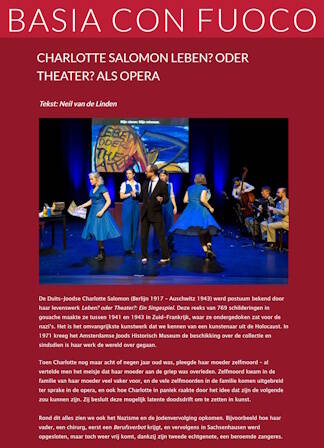
The singing is brilliant, with razor-sharp harmonies from the vocal quartet and baritone Florian Just. The four members of Wishful Singing play all the female roles, with baritone Florian Just playing singing teacher Amadeus Daberlohn, and the three musically virtuoso instrumentalists also beautifully portraying Charlotte's father, her grandfather, and the increasingly visible Nazis in the street scene.
It is also good that Wishful Singing sometimes dares to sing rough in this production.
And you'll also see a lot of Charlotte Salomon's work. The many family troubles, including all those suicides, are extensively covered but play a prominent role in Charlotte's work, so rub it in.
De Theaterkrant, Thea Derks, April 24, 2026
For two hours, her colorful gouaches, exuberantly inscribed with text, appear on the backdrop, often in literal connection with the action on stage. In this way, stage director and librettist Annechien Koerselman illustrates the inextricable link between the life and work of Charlotte Salomon (1917-1943), who was gassed in Auschwitz in 1943.
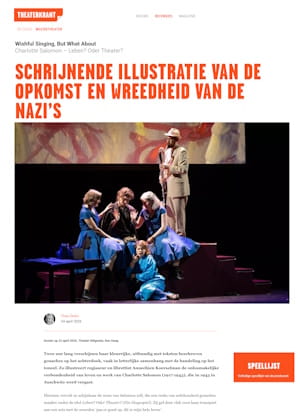
The four singers of Wishful Singing and three musicians of But What About? portray all the characters in the stories that unfold. This is cleverly staged with simple costumes.
The role of Charlotte is consistently sung by two singers; the 22-year-old dressed in a flowing blue dress, the 25-year-old in a blue suit. It is a beautiful illustration of her inner struggle, which at times yields fine lyrical two- and four-part vocal parts.
Salomon grew up in Berlin, and Weill worked closely with Bertolt Brecht. Koerselman also employs the latter's technique of 'alienation,' by having the characters sometimes step out of their roles and comment on the action as an objective narrator. A defensible choice that works strongly at times.
Meanwhile, Salomon's gouaches poignantly illustrate the rise and cruelty of the Nazis. Impressive is the moment when the accordionist menacingly steps forward and shouts phrases such as 'Drum haut noch mal beim Judenschwein die Scheiben kurz und klein. Denn spritzt vom Messer Judenblut, dann geht es euch nochmal so Gut.' To which his fellow musicians roar 'Aus Raus!' When Paulinka recounts how she wants to flee to America with Charlotte's father but encounters an unyielding rejection from the consul: 'Kein Visum für Juden!', a shiver briefly runs through the hall.
The ending is beautiful too. Charlotte recounts how the characters survived the war and recalls how she herself was deported to Auschwitz on October 7, 1943: 'Upon my arrival, I was immediately sent into the gas chamber.'
Prepublicity
De Volkskrant, Guido van Oorschot, September 25, 2025
"Beautiful!" a voice calls from the darkness. Stage director Annechien Koerselman is finalizing the details, ten days before the premiere of the new opera Charlotte Salomon – Leben? oder Theater? (Life or Theater?). She's wondering if the soprano could fall more easily. If the baritone would sigh more desperately. Everything will come together on Saturday, September 27th, at the Flint Theatre in Amersfoort, followed by an extensive tour.
Annechien Koerselman also directed back then. This time, she provided the impetus that led from choral piece to opera. "Opera, after all, is about life's great dramatic moments," she says. "Well, here we have one. Isn't it incredible, to be lied to for so long about your mother's death? Charlotte learned of it shortly after her grandmother had attempted suicide—which she ultimately succeeded in doing. She was so upset by it that she wanted to unravel her own existence."
The story isn't even that complex, but she portrays it intuitively, with many sidetracks. In my stage adaptation, I'm aligning it with a so-called family constellation, a well-known form of psychotherapy. For me, it's a theatrical way to figure out how Charlotte relates to the other characters.
"He believed you could only create true art if you had faced death head-on. Charlotte adopted that idea from him." Kamperman: "But she also mocks him. She portrays him as a mansplainer who juggles theories." Koerselman: "It remains unclear whether they had an affair. Charlotte was extremely shy and perhaps escaped into a fantasy. Wolfsohn had already been in London for a long time when she painted some beautiful erotic scenes."
Koerselman: My impression is that Charlotte overcame her traumas through painting. Without the Holocaust, she probably would have gotten her life back on track. I don't think she would have followed in the footsteps of her aunt, mother, and grandmother. Kamperman: "Viewed that way, our performance offers hope. Charlotte also tells a story about how to endure in difficult times." Koerselman: "Persevering through adversity. Always creating beautiful things."